

I hope you are having a good weekend wherever you are.
Today’s post is about two things I’ve read recently and which I think you will enjoy.
First is a new book by my colleague at Oxford, the brilliant Elleke Boehmer. Elleke is Professor of World Literature in English at the University of Oxford and someone whose work I have admired for a long time.
Her new book is a ground-breaking study titled Southern Imagining: A Literary and Cultural History of the Far Southern Hemisphere
I was honoured to be sent a copy before it was published this spring.
It is nothing if not ambitious - a major reorientation of literary, cultural, and planetary thought.
As the author rightly notes, the southern hemisphere has long been presented in scholarship and public imagination as marginal and derivative.
The book is a wonder and a revelation.
Rather than adding southern places into an existing map, Boehmer redraws the map altogether - placing the South at the centre and asking how this shift changes the way we think about culture, history, and the planet itself.
Some of the examples are fascinating.
For example, the author explains the history of one of the most famous images in history: earth as the ‘blue marble’ as taken by astronauts on Apollo 17.
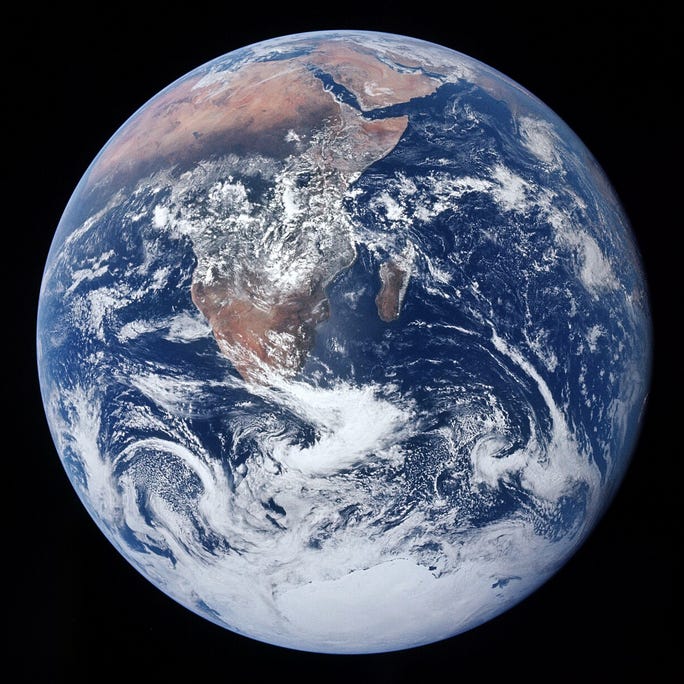
When newspapers around the world published the image (and indeed as shown here), it had been rotated.
In fact, the original photograph showed Antarctica at the top of the frame; but for publication, it was inverted so that the North Pole appeared at the top - as this is the view most people are familiar with.
This small but telling example though reveals how deeply ingrained northern orientation is: even when presented with a neutral, planetary image, editors adjusted it to conform to familiar hierarchies.
The anecdote neatly encapsulates the book’s central argument - that perspective is never neutral, and that even our view of the whole Earth is shaped by inherited assumptions.
Many things make this book exciting.
One is the scale of the author’s vision: this is not just a study of a region, but a rethinking of how we understand space and perspective. Boehmer moves across oceans and continents, from southern Africa to Australia, from South America to Antarctica, tracing connections that are usually if not always overlooked. She shows that the southern hemisphere is not a collection of isolated places, but a vast, interconnected world shaped by shared skies, winds, currents and histories.
It is also an outstanding case study in how to bring in brings voices from the southern hemisphere and to place them in the centre of the conversation.
The author foregrounds southern and Indigenous perspectives, treating them as sources of insight in their own right.
Writers, poets and storytellers from across the South are not simply responding to European traditions; they are shaping entirely different ways of understanding place, time, and connection.
Not surprisingly, what emerges as a result is a layered, nuanced and important account of how the South has been imagined - not just from afar, but by those who live there.
This includes attention to oral traditions, star knowledge and local languages - all of which which encode relationships between land, sea, and sky that are often absent from northern frameworks.
It is a mightily impressive achievement - and a book that I not only enjoyed immensely, but learned a great deal from.
Writing about networks and connections, and reorienting how we think about history, geography, literature, knowledge and more is not easy.
You’ll enjoy this enormsouly if you like Global Threads; so do pop into your local bookshop to get a copy.
As a historian of exchange, I’ve long been interested in disease environments, pathogens and the deep impacts that both have had on human societies.
In The Earth Transformed, for example, I wrote about how low levels of resistence to infectious disease correlates with long-range low levels of trust in parts of West Africa; I wrote too about how genetic mutation that provided resistance to malaria in some Bantu populations provided not only competitive advantage but was crucial in shaping settlement patterns as well as the diffusion of language, cultural norms - and more.
So I’ve been reading a new paper that has just been published in Science Advances with great interest. Its title is ‘Malaria shaped human spatial organization for the past 74 thousand years’
A team of scholars from a clutch of leading European centres of excellence (including Max Planck in Jena, Cambridge, the Natural History Museum and more) have been looking not only at changes to climate environments over tens of thousands of years - and how these not only impact human interactions, but how they affected the dispersal of Plasmodium falciparum–induced malaria from around 74,000 years ago until around 5,000 years ago.
The authors, led by Margherita Colucci, have modelled the ecological niches of mosquito vectors - especially Anopheles gambiae, Anopheles funestus and coastal species such as Anopheles melas.
By combining these with palaeoclimatic data, the team have generated what they call a ‘malaria stability index’ - namely a set of criteria to determine how suitable conditions were for mosquitoes, and therefore for the transmission of malaria.
The results are impressive not least since they show that areas with high malaria stability consistently correspond wiht low levels of human settlement.
In other words, early human populations did not simply expand into all climatically viable regions; in fact, they avoided (or failed) to establish themselves in areas where malaria risk was high.
This helps shape further ideas about ‘human niche’ zones - places where risk of infectious disease was low. Or, to put it another way, malarial disease acted as a spatial constraint for early human societies, helping determine corridors of movement and explaining population and settlement distribution in ways that climate alone cannot explain.
Intriguingly, the model shows that around 60,000–50,000 years ago - just as humans began to leave Africa in significant numbers - conditions for malaria were intensifying. This suggests that those movements were not driven by climate alone, but also by the need to navigate landscapes where disease risk was becoming harder to avoid.
While the suggestion here is tentative, it is possible that some groups chose to vacate high-risk zones and moved into new regions where exposure to infectious disease was lower. Additionally, say the authors, humans themselves may have been unwitting transmitters too - because they carried the disease with them as they relocated.
I’m particualrly interested because of the challenge this poses to historians. For a long time, disease has been treated as episodic - something that arrives in waves, disrupts societies and then recedes.
This paper though suggests something more fundamental: that disease environments were always crucial, and played not just important but decisive roles inshaping where people could live, how they moved and how they interacted over tens of thousands of years.
That has implications not only for how we think about early human history, but for later patterns too of settlement, inequality and connections - including in the modern world.
Plenty to think about then.
More soon.